
Restricted Breeds and Dangerous Dogs: Breed Lists, Tax & Requirements
What restricted breeds are, how dog tax differs for them, and which proof (expertise, dog licence) is required in each federal state.
What are restricted breeds?
Restricted breeds (colloquially also called “dangerous dogs” or “Kampfhunde”) are dogs of certain breeds or crossbreeds that are classified as potentially dangerous by state law or ordinance — regardless of the individual animal’s actual behaviour. Additional requirements usually apply to them, such as mandatory leashing and muzzling, as well as a behavioural test.
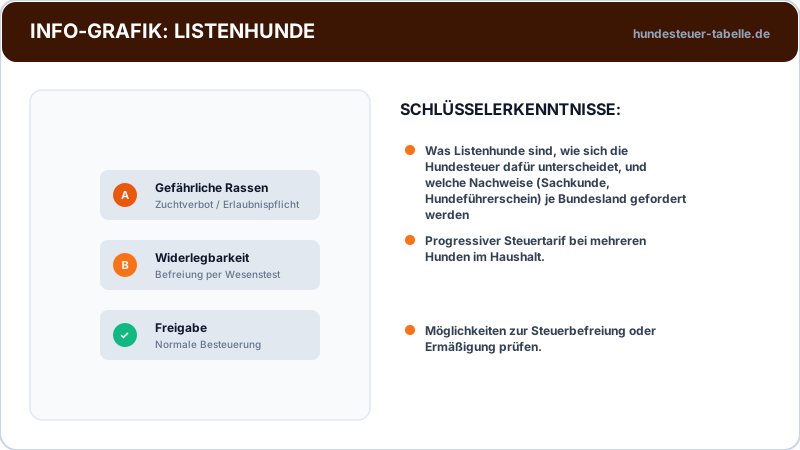 Figure: Simple explanation and summary on the topic of restricted breeds and dangerous dogs: breed lists, tax & requirements.
Breed lists are a state matter
The exact breed list is not set nationwide, but individually by each federal state through a state dog act or hazard-prevention ordinance. In concrete terms, this means a dog considered a restricted breed in one federal state need not be one in another. Our state pages each note a reference to the relevant legal basis — for the exact, current breed list we refer you to the responsible regulatory authority, since lists can change.
Higher dog tax for restricted breeds
Many, though not all, municipalities charge a significantly higher tax rate for restricted breeds than for “normal” dogs. Examples from our researched database:
- Wuppertal: €1,000 a year for dangerous dogs
- Essen: €852 a year
- Bonn: tiered — €780 for the first, €1,020 for the second and each additional dangerous dog
- Berlin and Cologne: currently no increased rate for restricted/dangerous breeds
You’ll find the exact, source-verified rates on the respective city page.
Proof of expertise and dog licence
In several federal states, keeping certain dogs requires a proof of expertise (“dog licence”) — a theoretical and/or practical demonstration that the owner can handle the dog safely. Whether this requirement applies only to restricted breeds or to all dogs in general varies by federal state and is governed by the respective state dog ordinance.
Important note
Restricted-breed rules touch not only tax questions but also regulatory law and animal welfare. Before acquiring a potentially listed dog, be sure to check the current requirements with the regulatory authority of your federal state and municipality.
Related Guide Articles

The American Staffordshire Terrier: Requirements and Tax Rates in Germany
Ownership rules for the AmStaff: classification as a restricted breed, import bans, and the amount of the dangerous-dog tax in detail.

Bull Terriers in Germany: State-by-State Ownership Rules
Ownership requirements, breed lists, and tax rates for the Bull Terrier and Miniature Bull Terrier compared.

The Dogo Argentino: Breed List Status, Temperament, and Tax Rates
Everything about keeping a Dogo Argentino: which federal states put it on the breed list and what taxes apply.